Polyvagal Theory Explains Why You Are the Way You Are
Understanding Polyvagal Theory — how your nervous system keeps you safe, alive, and connected.
Polyvagal Theory, developed by Dr. Stephen Porges, explains how our autonomic nervous system works to keep us safe, alive, and connected — to ourselves and to others.
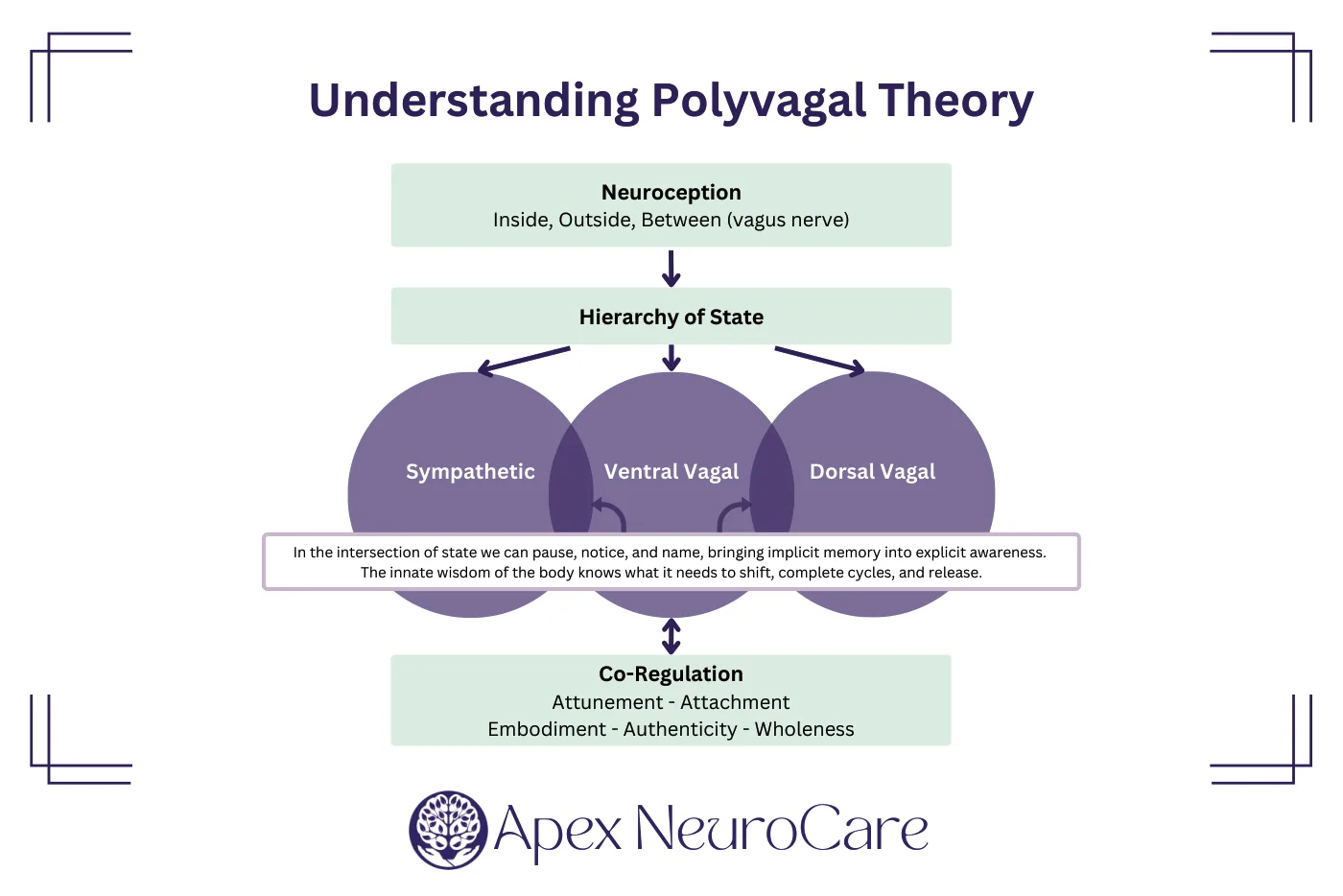
Neuroception: your safety scanner
Your nervous system automatically scans for cues of safety and danger — in three directions.
Inside
What's happening within your body — heart rate, breathing, digestion, energy, sensation.
Outside
The world around you — sounds, sights, movement, and the overall environment.
Between
Other people — facial expressions, tone of voice, eye contact, presence. We're deeply relational.
Hierarchy of state: your nervous system's ladder
Our three states are organized in a hierarchy — an adaptive ladder. As the autonomic nervous system reads cues of safety and danger, it moves us along it: from ventral vagal (safety and connection), to sympathetic (fight or flight), to dorsal vagal (shutdown).
Safety
Calm, grounded, connected, creative.
Mobilized
Fight or flight — alert, prepared to act.
Shutdown
Freeze — low energy, numbness, disconnection.
None of these states are bad. Each is an adaptive response designed to help us survive. Read more about the three states →
Where we can slow down and get curious
Where ventral vagal overlaps with sympathetic and dorsal, there are important spaces — places where we can slow down and become curious about our experience, noticing thoughts, emotions, body sensations, and reactions with greater awareness. With support, we can work gently with these experiences through somatic parts work, somatic EMDR, and other body-based practices.
Healing doesn't come from forcing change. It comes from creating enough safety for the nervous system to move naturally toward regulation.
Co-regulation: healing happens in relationship
Co-regulation is the process by which nervous systems help one another feel safe. From birth, we rely on caring relationships to help regulate our emotions and physiology. When a caregiver responds with warmth, attunement, and consistency, a child's nervous system learns that the world is safe and relationships can be trusted.
These early experiences shape attachment patterns — but they do not determine our future. At any age, we can develop greater security, resilience, and connection. As attunement deepens, trust grows; as trust grows, we become more embodied — more connected to who we truly are. And from that place of authenticity, we move toward wholeness.
Understanding Polyvagal Theory — Printable Poster
A clear, printable diagram of Dr. Stephen Porges's Polyvagal Theory — neuroception, the three states, and co-regulation.
Are you ready to return to wholeness?
Contact me to discuss whether trauma-informed nervous system coaching is your next best step.
Book a Free Consultation